nikon d5500 manual
nikon d5500 manual
Nikon D5500 Manual: A Comprehensive Guide
Welcome! This guide provides a detailed exploration of the Nikon D5500 DSLR camera. Numerous online resources, including manualsdir.ru and manualza.com, offer 160-page instructions for optimal usage.
The Nikon D5500 is a versatile and popular DSLR camera, renowned for its excellent image quality and user-friendly design. Released as a successor to the D5300, it builds upon its predecessor’s strengths, offering enhancements in performance and features. This camera is an excellent choice for both beginners venturing into the world of DSLR photography and enthusiasts seeking a capable and compact system.
As indicated by readily available online manuals from sources like manualsdir.ru and manualza.com, the D5500 boasts a 24.2-megapixel DX-format CMOS sensor, delivering sharp, detailed images even in challenging lighting conditions. Its 3.2-inch vari-angle touchscreen LCD monitor allows for flexible composition and easy navigation through menus. The camera’s compact and lightweight body makes it comfortable to carry and handle during extended shooting sessions.
Understanding the intricacies of the D5500 requires a thorough exploration of its features, settings, and operational modes. This guide will serve as a comprehensive resource, walking you through each aspect of the camera, from basic controls to advanced techniques. Whether you’re capturing stunning landscapes, portraits, or action shots, the Nikon D5500 empowers you to unleash your creative potential. Accessing the 160-page instruction manual online will further enhance your learning experience.
Understanding the Camera’s Key Features
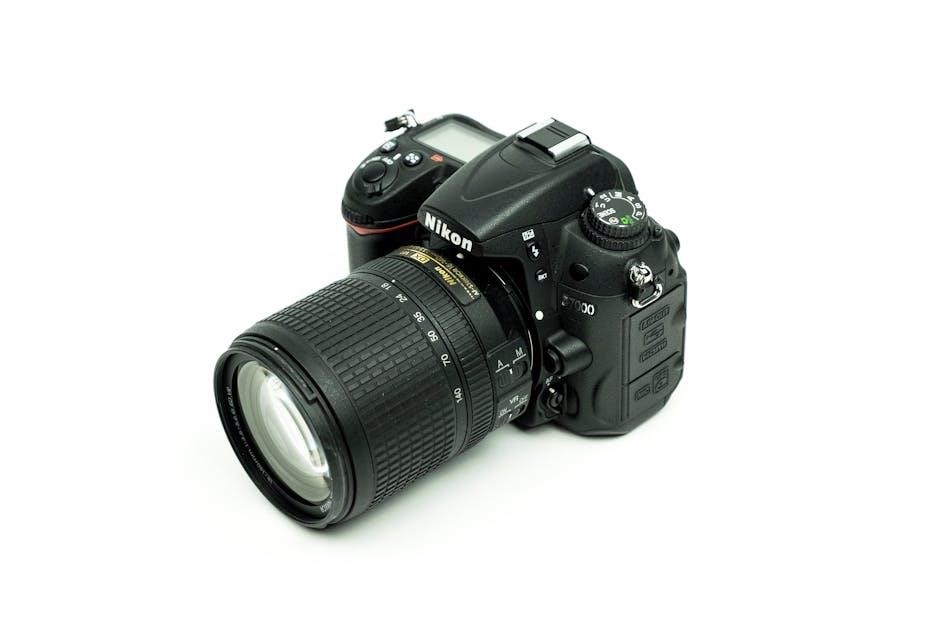
The Nikon D5500 distinguishes itself through several key features, detailed in available online manuals from resources like manualsdir.ru and manualza.com. Central to its performance is the 24;2-megapixel DX-format CMOS sensor, enabling high-resolution images with impressive clarity and dynamic range. This sensor, combined with the EXPEED 4 image processor, delivers excellent low-light performance and reduced noise.

A standout feature is the 3.2-inch vari-angle touchscreen LCD. This allows for comfortable shooting from various angles, facilitating both still photography and video recording. The touchscreen interface also simplifies menu navigation and image review. The D5500 incorporates a 39-point autofocus system, ensuring swift and accurate subject tracking, crucial for capturing fast-moving subjects.
Connectivity is enhanced by built-in Wi-Fi, enabling seamless image transfer to smartphones and tablets for instant sharing. The camera also supports remote control via a mobile device. Furthermore, the D5500 offers Full HD 1080p video recording at up to 60 frames per second, providing smooth and detailed video footage. These features, comprehensively documented in the 160-page manual, contribute to the D5500’s versatility and appeal.
Navigating the Menu System
The Nikon D5500’s menu system, thoroughly explained in manuals available on sites like manualsdir.ru and manualza.com, is logically organized into several tabs, each dedicated to specific camera settings. These tabs – Shooting, Display, Setup, Custom Settings, and Retouch – provide access to a wide range of customizable options. The 3.2-inch vari-angle touchscreen LCD significantly simplifies menu navigation, allowing for direct selection and adjustment of settings.
The Shooting menu controls image quality, shooting mode, and autofocus settings. The Display menu manages information displayed on the LCD and in the viewfinder. The Setup menu handles general camera settings like date/time, language, and Wi-Fi connectivity. The Custom Settings menu allows for personalized control assignments, tailoring the camera to individual shooting preferences.
Understanding the menu structure is crucial for unlocking the D5500’s full potential. The 160-page instruction manual details each menu option, providing clear explanations and guidance. Utilizing the ‘Help’ function within the camera’s menu offers contextual assistance, explaining the purpose of each setting. Mastering the menu system empowers users to fine-tune the camera for optimal performance in any shooting scenario.
Shooting Modes Explained
The Nikon D5500 offers a versatile array of shooting modes, detailed in comprehensive manuals found on resources like manualsdir.ru and manualza.com, catering to both beginners and experienced photographers. These modes are accessed via the mode dial on the camera’s top panel. Auto mode simplifies operation, letting the camera handle all settings. Scene modes, such as Portrait, Landscape, and Sports, optimize settings for specific subjects.
Program Auto (P) allows control over ISO, white balance, and image quality while the camera sets aperture and shutter speed. Aperture-Priority (A) lets you choose the aperture, influencing depth of field, while the camera selects the shutter speed. Shutter-Priority (S) allows control over shutter speed, useful for capturing motion, with the camera adjusting the aperture.
Manual (M) provides full control over both aperture and shutter speed, offering maximum creative flexibility. Additionally, Effects mode provides creative filters. The 160-page manual thoroughly explains each mode, including when and how to use them effectively. Understanding these modes is key to achieving desired photographic results, allowing photographers to move beyond automatic settings and explore their creative vision.
Understanding Exposure: Aperture, Shutter Speed, and ISO
Exposure, crucial for well-lit photographs, is controlled by three key elements: aperture, shutter speed, and ISO. The Nikon D5500 manual, available on sites like manualsdir.ru and manualza.com, details how these interact. Aperture, measured in f-stops (e.g., f/2.8, f/16), controls the lens opening, affecting depth of field – a wider aperture (lower f-number) creates shallow depth of field, blurring the background.
Shutter speed, measured in seconds or fractions of a second (e.g., 1/200s, 1s), determines how long the sensor is exposed to light. Faster shutter speeds freeze motion, while slower speeds allow more light in but can cause blur. ISO measures the sensor’s sensitivity to light; higher ISO values are useful in low light but can introduce noise (grain).
Mastering the relationship between these three settings is fundamental to photography. The 160-page manual provides practical examples and guidance on balancing aperture, shutter speed, and ISO to achieve proper exposure in various shooting conditions. Understanding these concepts unlocks creative control over your images.
Autofocus System and Settings
The Nikon D5500 boasts a 39-point autofocus (AF) system, detailed in the comprehensive manual found on resources like manualsdir.ru and manualza.com. This system allows for precise and rapid subject tracking. AF-S (Single Servo) is ideal for stationary subjects, locking focus when the shutter button is half-pressed. AF-C (Continuous Servo) continuously adjusts focus, perfect for moving subjects.
Focus Area Modes determine which AF points the camera uses. Single-point AF lets you select a specific point, while Dynamic-area AF uses surrounding points to maintain focus on a moving subject. Auto-area AF automatically selects AF points, suitable for general shooting. The manual explains how to customize these settings.
Fine-tuning AF performance is possible through the AF Fine Tune option, compensating for slight lens imperfections. Understanding these settings, as outlined in the 160-page guide, is crucial for capturing sharp, in-focus images consistently. Experimenting with different modes will help you optimize autofocus for various shooting scenarios.
Image Quality Settings and File Formats
The Nikon D5500, as detailed in manuals available on sites like manualsdir.ru and manualza.com, offers a range of image quality settings impacting file size and detail. You can choose between RAW and JPEG formats. RAW files retain all image data, providing maximum flexibility for post-processing, but are larger in size. JPEG files are compressed, resulting in smaller files suitable for immediate use, but with some loss of detail.
Within JPEG settings, you can select different quality levels – Fine, Normal, and Basic. Fine offers the highest quality, while Basic provides the smallest file size. The 160-page manual thoroughly explains these options. Additionally, you can choose image size (Large, Medium, Small), influencing the resolution and printability of your photos.
Understanding these settings is vital for balancing image quality with storage space. For critical work, RAW is recommended. For everyday shooting and quick sharing, JPEG offers a convenient balance. The manual provides guidance on selecting the optimal settings for your specific needs and shooting conditions.
Working with the Viewfinder and Live View
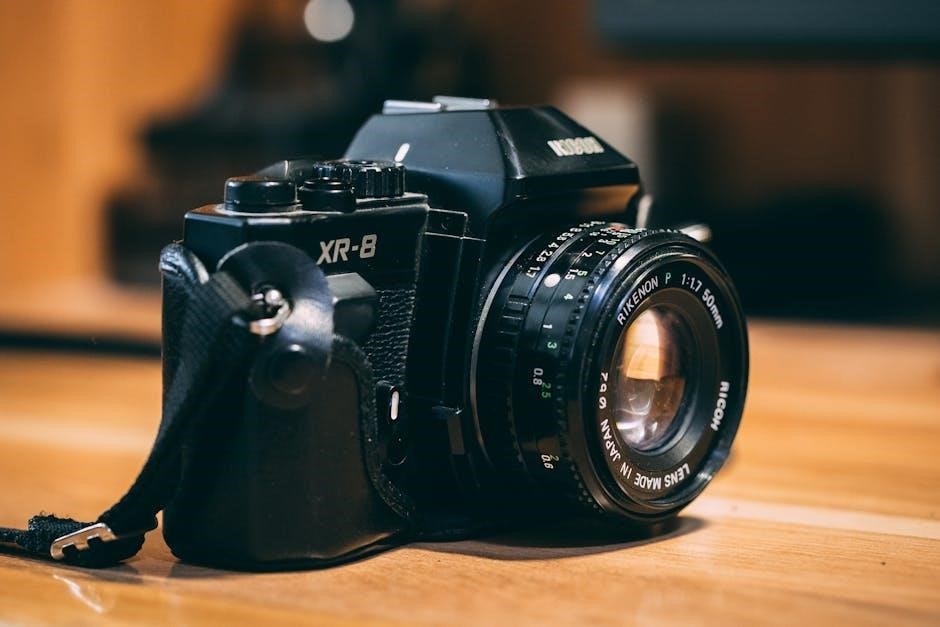
The Nikon D5500, as detailed in comprehensive manuals found on resources like manualsdir.ru and manualza.com, offers two primary ways to compose your shots: through the optical viewfinder and using Live View. The viewfinder provides a clear, real-time view directly through the lens, ideal for fast-moving subjects and bright conditions. It offers approximately 95% coverage of the frame.
Live View, activated via a switch on the back of the camera, displays the image on the LCD screen. This allows for precise composition, especially when using manual focus, and is beneficial for shooting at awkward angles. The 160-page manual explains how Live View utilizes phase-detection autofocus for faster performance.
Live View also enables features like grid display and exposure simulation, helping you visualize the final image before capturing it. However, it consumes more battery power and can be slower for tracking moving subjects compared to the viewfinder. Mastering both methods allows you to adapt to various shooting scenarios and maximize the D5500’s capabilities.
Utilizing the Built-in Flash
The Nikon D5500, as detailed in manuals available on sites like manualsdir.ru and manualza.com, features a built-in flash unit, a convenient tool for illuminating scenes with insufficient light. Accessed via a release button on the camera’s hot shoe, the flash offers several modes to suit different situations. Auto mode lets the camera determine when and how much flash to use, while Manual mode provides full control over flash power.
Fill-Flash mode adds a touch of light to brighten shadows in brightly lit scenes, and Slow Sync combines the flash with a slower shutter speed, useful for capturing ambient light alongside the subject. The 160-page manual explains how to adjust flash compensation to fine-tune the flash output.
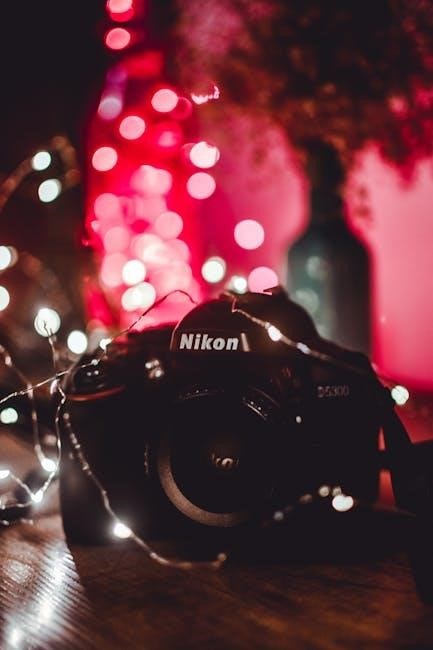
Remember that the built-in flash has limitations, including a limited range and potential for harsh shadows. For more advanced flash photography, consider an external flash unit, which offers greater power, flexibility, and control. Understanding the built-in flash’s capabilities is a great starting point for improving your photography in challenging lighting conditions.
Customizing Camera Settings
The Nikon D5500, as outlined in comprehensive manuals found on resources like manualsdir.ru and manualza.com, offers extensive customization options to tailor the camera to your shooting style. Accessing the Setup menu unlocks a world of personalized settings. You can adjust the button assignments, customizing which functions are triggered by each control. This allows for quicker access to frequently used features.
Custom Picture Controls let you create and save your preferred color and tone profiles. The 160-page manual details how to adjust settings like sharpness, contrast, and saturation. You can also customize the information displayed in the viewfinder and on the LCD screen.
Furthermore, the D5500 allows you to save custom shooting presets, storing combinations of settings for specific scenarios. This is incredibly useful for quickly switching between different shooting conditions. Exploring these customization options, as detailed in the user guide, empowers you to optimize the camera for your individual needs and preferences, enhancing your overall shooting experience.
Understanding White Balance
Achieving accurate colors is crucial in photography, and the Nikon D5500, as detailed in its manual available on sites like manualsdir.ru and manualza.com, provides robust white balance controls. White balance corrects color casts caused by different lighting conditions, ensuring your images appear natural. The camera offers several preset white balance modes, including Daylight, Cloudy, Fluorescent, and Incandescent, catering to common scenarios.
For more precise control, the D5500 features a Custom white balance setting. This allows you to manually set the white point by photographing a white or gray card under the current lighting. The 160-page manual explains this process step-by-step. You can also fine-tune the white balance using the Kelvin temperature setting, adjusting the color temperature in degrees Kelvin.
Understanding and utilizing these white balance options, as outlined in the user guide, is essential for capturing true-to-life colors and avoiding unwanted color casts in your photographs. Experimenting with different settings will help you master this important aspect of photography.
Picture Control Settings
The Nikon D5500, as detailed in manuals found on resources like manualsdir.ru and manualza.com, offers Picture Control settings – a powerful tool for customizing the look of your images directly in-camera. These settings allow you to adjust the tone, contrast, sharpness, and saturation of your photos without post-processing.
The camera provides several preset Picture Controls, including Standard, Neutral, Vivid, Monochrome, and Portrait. Standard is a versatile all-purpose setting, while Vivid boosts colors for a more vibrant look. Portrait softens skin tones, and Monochrome creates black and white images. You can further customize these presets or create your own User Defined Picture Controls.
Each Picture Control has adjustable parameters. The 160-page manual explains how to modify these settings to achieve your desired aesthetic. Experimenting with these controls allows you to develop a unique photographic style. Remember to save your custom settings for consistent results. Mastering Picture Controls enhances your creative control over your images.
Video Recording Features
The Nikon D5500, as outlined in comprehensive manuals available on sites like manualsdir.ru and manualza.com, boasts impressive video recording capabilities for its class. It supports Full HD 1080p video at frame rates of up to 60 frames per second, allowing for smooth and detailed footage. The 160-page instruction manual details various settings to optimize video quality.
The camera offers a range of video-specific features, including an external microphone input for improved audio recording; This is crucial for professional-sounding videos. You can also manually control exposure settings like aperture, shutter speed, and ISO during video recording, providing creative flexibility.
Furthermore, the D5500 supports focus peaking, a helpful tool for achieving sharp focus in video. The manual explains how to utilize this feature effectively. The camera’s autofocus system also functions during video recording, though performance may vary. Explore the menu options to customize video settings and unlock the full potential of the D5500’s video features.
Connecting to a Computer and Transferring Images
The Nikon D5500, as detailed in its 160-page manual found on resources like manualsdir.ru and manualza.com, offers several methods for transferring images to a computer. The most common is via a USB cable, allowing for a direct connection. Upon connection, the camera may appear as a removable drive, enabling simple drag-and-drop file transfer.
Alternatively, Nikon provides software like ViewNX-i and Capture NX-D (often downloadable from Nikon’s website) for more advanced image management and editing. These programs facilitate organized importing, tagging, and basic adjustments. The manual thoroughly explains the installation and usage of these applications.
For wireless transfer, the D5500 is compatible with Nikon’s SnapBridge app. This allows for automatic image transfer to your smartphone or tablet via Bluetooth. The manual provides step-by-step instructions for pairing the camera and configuring SnapBridge. Ensure you have the latest firmware for optimal compatibility and functionality during the transfer process.
Troubleshooting Common Issues
The Nikon D5500 manual, available on sites like manualsdir.ru and manualza.com, dedicates sections to resolving frequent problems. A common issue is card errors; ensure the card is correctly inserted and not write-protected. Formatting the card in the camera is often the solution, but remember this erases all data.
If the camera won’t power on, check the battery charge and ensure it’s properly installed. A malfunctioning battery or loose connection are typical causes. Another frequent concern is autofocus issues. Verify the autofocus mode is appropriate for the subject and that the focus point is correctly selected.

Image quality problems, like blurry photos, can stem from incorrect settings (shutter speed too slow, aperture too wide) or camera shake. Utilize the image stabilization feature and a tripod when necessary. If the LCD screen displays errors, consult the manual’s error code list for specific troubleshooting steps. Regularly updating the camera’s firmware can also resolve bugs and improve performance.
Care and Maintenance of Your Nikon D5500
The Nikon D5500 manual, readily accessible through resources like manualsdir.ru and manualza.com, emphasizes proper care for longevity. Regularly clean the camera body with a soft, dry cloth. Avoid abrasive cleaners or solvents, which can damage the finish.
Lens care is crucial: use a lens cleaning cloth and solution specifically designed for camera lenses. Dust and fingerprints on the sensor can degrade image quality; utilize a sensor cleaning kit cautiously, following the manual’s instructions precisely. Store the camera in a dry, dust-free environment, ideally in a camera bag.
Protect the camera from extreme temperatures and humidity. Avoid dropping or subjecting it to strong impacts. Battery care involves removing the battery for extended storage to prevent leakage. Periodically check the contacts for corrosion. Finally, keep the firmware updated, as updates often include performance enhancements and bug fixes, contributing to the camera’s overall health and reliability.