calisthenics exercises list pdf
calisthenics exercises list pdf
Calisthenics Exercises List: A Comprehensive Guide
Calisthenics offers diverse training, from basic movements to advanced skills, adaptable anytime and anywhere, mirroring a fitness surge seen across social media platforms today.
What is Calisthenics?
Calisthenics, rooted in ancient Greek training methods dating back to 326 BC, is a form of exercise utilizing only your body weight for resistance. It’s a versatile discipline, offering a pathway to fitness accessible to all levels, requiring no specialized equipment – making it truly adaptable for workouts anytime, anywhere.
Unlike traditional weightlifting relying on external loads, calisthenics focuses on mastering fundamental movements like pushing, pulling, squatting, and planking. This builds functional strength, endurance, and flexibility simultaneously. The recent explosion in its popularity, evidenced by over 18.5 billion views on social media under the #calisthenics hashtag, demonstrates a growing interest in this effective and accessible training style.
From beginner-friendly exercises to incredibly challenging skills like muscle-ups and the human flag, calisthenics provides a scalable progression for continuous improvement. It’s a return to foundational movement patterns, offering a holistic approach to physical conditioning.
The History of Calisthenics
Calisthenics boasts a rich history, originating in ancient Greece around 326 BC. The term itself derives from the Greek words “kalos” (beauty) and “sthenos” (strength), reflecting the pursuit of a physically aesthetic and capable body. Ancient Greeks employed these exercises – often involving rhythmic movements – to prepare soldiers for battle and to cultivate physical fitness for athletic competitions.
Throughout history, variations of calisthenics have appeared in diverse cultures, serving as foundational training for military personnel and gymnasts. While its popularity waned with the rise of modern weightlifting, calisthenics experienced a resurgence in the 20th century, particularly within physical education programs.
More recently, it’s exploded onto the fitness scene, fueled by social media and a desire for accessible, equipment-free workouts. This revival demonstrates a renewed appreciation for the fundamental principles of bodyweight training and its enduring benefits.
Benefits of Calisthenics Training
Calisthenics provides a multitude of benefits, foremost among them being enhanced muscle strength. Unlike weightlifting, which relies on external resistance, calisthenics utilizes your own bodyweight, fostering functional strength applicable to everyday movements. This approach improves muscular endurance, allowing you to perform activities for longer periods without fatigue.
Furthermore, calisthenics significantly boosts core strength and stability, crucial for maintaining proper posture and preventing injuries. Its accessibility is a major advantage – requiring minimal to no equipment, enabling workouts anywhere, anytime. This flexibility promotes consistency and makes fitness attainable for everyone.
Beyond physical gains, calisthenics enhances body awareness, coordination, and control, contributing to a lean, athletic physique and overall well-being.
Calisthenics vs. Weightlifting
Calisthenics and weightlifting represent distinct approaches to strength training, each with unique advantages. Weightlifting utilizes external resistance – dumbbells, barbells, machines – to build muscle mass and strength, often focusing on isolating specific muscle groups. Calisthenics, conversely, leverages bodyweight for resistance, emphasizing compound movements that engage multiple muscle groups simultaneously.
While weightlifting excels at maximizing hypertrophy (muscle growth), calisthenics prioritizes functional strength, improving real-world movement patterns and coordination. Calisthenics is generally more accessible, requiring minimal equipment, whereas weightlifting often necessitates a gym membership and specialized gear.
Ultimately, the “better” method depends on individual goals; however, combining both can yield comprehensive fitness benefits, creating a well-rounded strength and conditioning program.
Beginner Calisthenics Exercises
Starting with foundational movements like push-ups, squats, planks, and lunges builds a base strength, preparing you for more challenging calisthenics progressions.
Push-Ups (Variations)
Push-ups are a cornerstone of calisthenics, effectively building upper body strength. Begin with standard push-ups, focusing on proper form – a straight line from head to heels. As you progress, explore variations to target different muscle groups and increase difficulty.
Incline push-ups, performed with hands elevated, reduce the load, making them ideal for beginners. Decline push-ups, with feet elevated, increase the challenge, emphasizing the upper chest and shoulders. Wide-grip push-ups broaden the focus to the chest, while close-grip push-ups target the triceps.
Diamond push-ups, forming a diamond shape with your hands, are particularly challenging for the triceps and inner chest. Don’t hesitate to start on your knees to master the form before attempting full push-ups. Consistent practice and progressive overload are key to improvement.
Squats (Variations)
Squats are fundamental for lower body strength and overall athleticism, forming a crucial part of any calisthenics routine. Start with bodyweight squats, ensuring proper form: feet shoulder-width apart, back straight, and descending as if sitting in a chair. As strength increases, introduce variations for enhanced challenge and muscle targeting.
Jump squats add a plyometric element, boosting power and explosiveness. Bulgarian split squats, performed with one foot elevated, improve balance and single-leg strength. Pistol squats, a highly advanced variation, require significant strength and control, involving squatting on one leg.
Sumo squats, with a wider stance and toes pointed outwards, emphasize the inner thighs. Remember to prioritize form over depth, gradually increasing range of motion as flexibility improves. Consistent practice builds strength and endurance.
Plank (Variations)
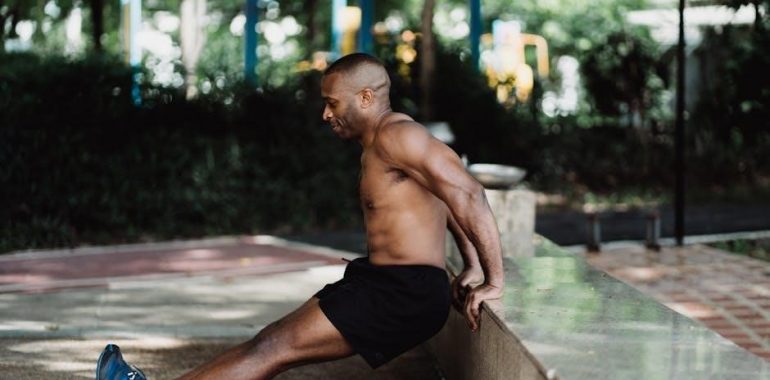
Planks are exceptional for core stability and endurance, serving as a cornerstone of calisthenics training. Begin with a standard plank, maintaining a straight line from head to heels, engaging your core, and holding for as long as possible with good form. This builds foundational strength.
Side planks target the obliques, enhancing rotational stability. Forearm planks reduce stress on the wrists. Plank jacks introduce a cardio element, increasing intensity. Walking planks challenge stability and coordination, moving between forearm and high plank positions.
Renegade rows, performed with hands in a plank position while lifting dumbbells, add a strength component. Focus on maintaining a neutral spine and avoiding hip sagging. Progressive overload, increasing hold time or adding variations, is key to continued improvement.
Lunges (Variations)
Lunges are fantastic for lower body strength and balance, a vital component of athletic conditioning. Start with the basic forward lunge, ensuring your front knee tracks over your ankle and your back knee lowers towards the ground. Maintain an upright torso and controlled movement.
Reverse lunges offer a different challenge, emphasizing glute activation. Walking lunges increase cardiovascular demand and dynamic stability. Lateral lunges target the inner and outer thighs, improving lateral movement. Curtsy lunges add a rotational element, engaging the glutes and core.
To increase difficulty, incorporate jump lunges for explosive power or hold dumbbells for added resistance. Proper form is crucial to prevent injury; focus on controlled descent and ascent throughout each variation.
Intermediate Calisthenics Exercises
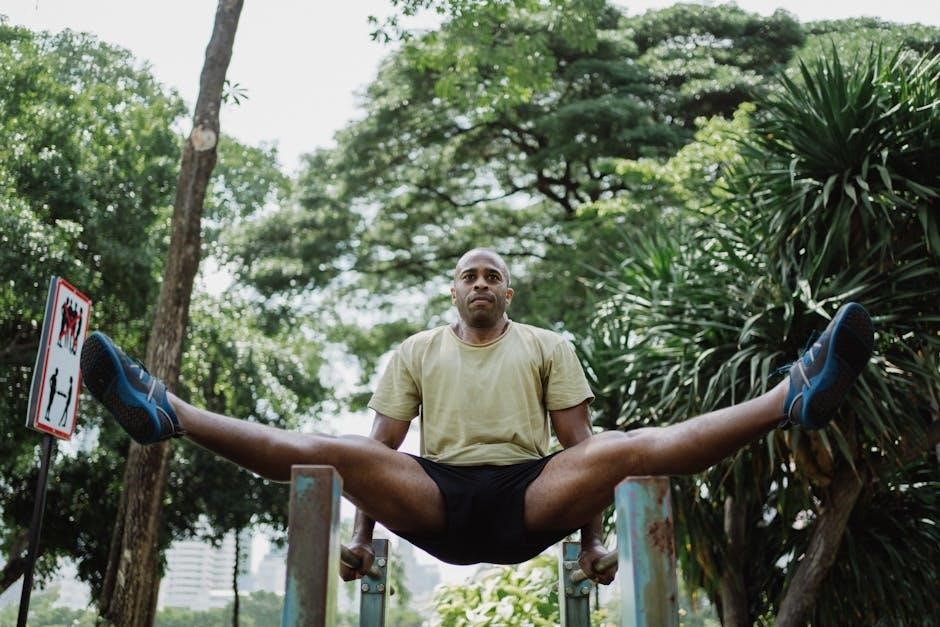
Progressing beyond beginner moves, intermediate calisthenics demand greater strength and control, building towards more complex skills and athletic performance capabilities.
Pull-Ups (Assisted & Strict)
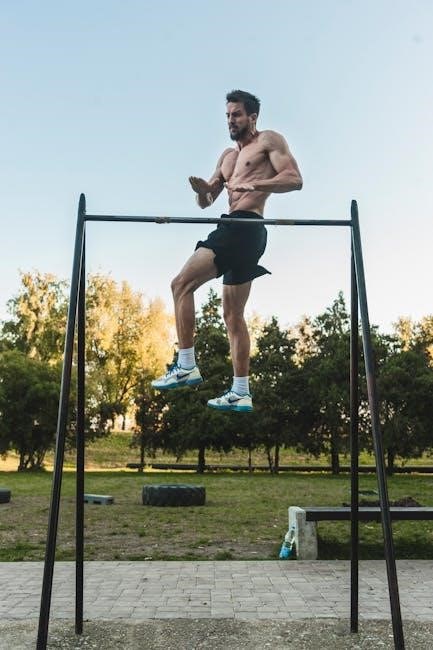
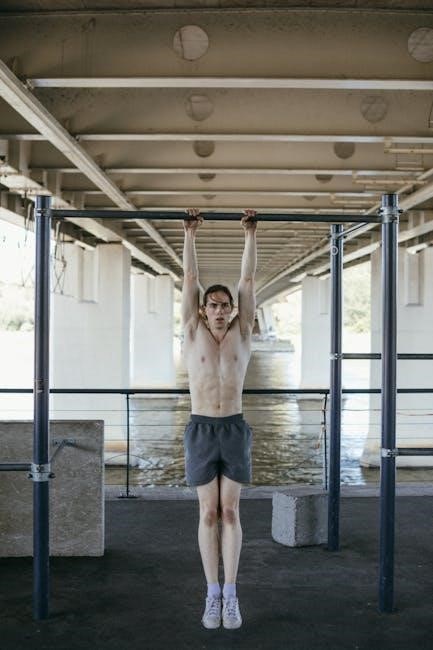
Pull-ups represent a cornerstone of intermediate calisthenics, demanding significant upper body strength and coordination. Initially, achieving strict pull-ups can be challenging; therefore, assisted variations are crucial for building foundational strength. These include using resistance bands looped around the bar and your feet, or employing an assisted pull-up machine if available.
As strength increases, gradually reduce assistance, aiming for unassisted repetitions. Proper form is paramount: maintain a full range of motion, starting from a dead hang and pulling yourself up until your chin clears the bar. Avoid swinging or using momentum. Focus on engaging your back muscles – lats, rhomboids, and traps – throughout the movement. Strict pull-ups not only build strength but also improve grip strength and posture. Variations like wide-grip, close-grip, and chin-ups (palms facing you) further challenge different muscle groups, enhancing overall upper body development.
Dips (Parallel Bars or Chair)
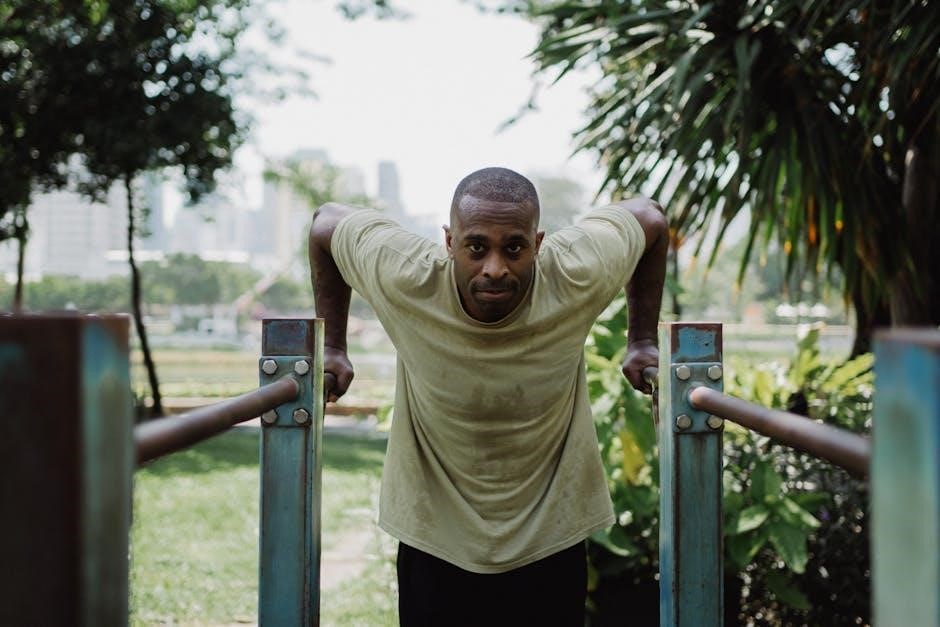
Dips are a highly effective intermediate calisthenics exercise primarily targeting the chest, triceps, and shoulders. They can be performed on parallel bars or utilizing a sturdy chair, making them accessible for home workouts. When using a chair, ensure it’s stable and won’t slide during the exercise. Begin by supporting your weight with your arms, keeping your elbows pointing backwards.
Lower your body by bending your elbows until your upper arms are parallel to the ground, then push back up to the starting position. Maintaining a controlled descent and ascent is vital to prevent injury and maximize muscle engagement. Assisted dips, using your feet to provide some support, are beneficial for beginners. Progress to unassisted dips as strength improves. Variations, such as weighted dips, can further increase the challenge and promote muscle growth.
Pistol Squats
Pistol squats represent a significant challenge in calisthenics, demanding substantial strength, balance, and coordination. This advanced exercise involves squatting down on a single leg while extending the other leg straight out in front. Mastering pistol squats requires a progressive approach, starting with assisted variations. Utilize a support, like a pole or doorframe, to maintain balance initially.
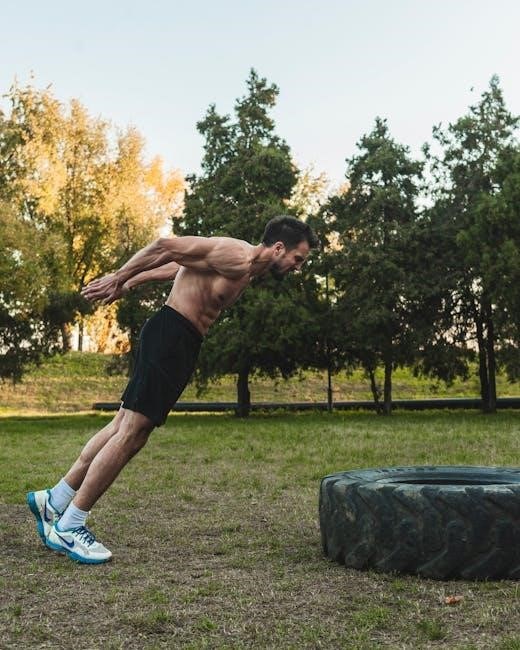
Focus on maintaining a straight back and keeping your weight centered over the supporting leg. Lower yourself as deeply as possible while controlling the movement. As strength and balance improve, gradually reduce reliance on assistance. Proper form is crucial to prevent injury; prioritize controlled movements over depth. Pistol squats effectively target the quads, glutes, and hamstrings, building impressive lower body strength and stability.
Advanced Calisthenics Exercises
Advanced calisthenics pushes limits with skills like muscle-ups, handstand push-ups, and the human flag, demanding dedication and significant physical conditioning.
Muscle-Ups
Muscle-ups represent a pinnacle of calisthenics achievement, blending pulling and pushing strength into one dynamic movement. This exercise typically performed on bars, requires significant technique and upper body power. The motion involves transitioning from a hanging position to supporting yourself above the bar, demonstrating both pull-up and dip capabilities.
Mastering muscle-ups demands a foundation of strict pull-ups and dips. Initially, assisted variations – using resistance bands or a spotter – are crucial for building the necessary strength and coordination. Focus on explosive pull-ups, aiming to get your chest to the bar, followed by a smooth transition into the dip phase. Proper form prevents injury and maximizes efficiency.
Progressive overload is key; gradually reduce assistance as strength increases. Drills like negative muscle-ups (slowly lowering from the top position) and band-assisted practice build the required muscle memory. Consistent practice and attention to technique will ultimately unlock this impressive calisthenics feat.
Handstand Push-Ups
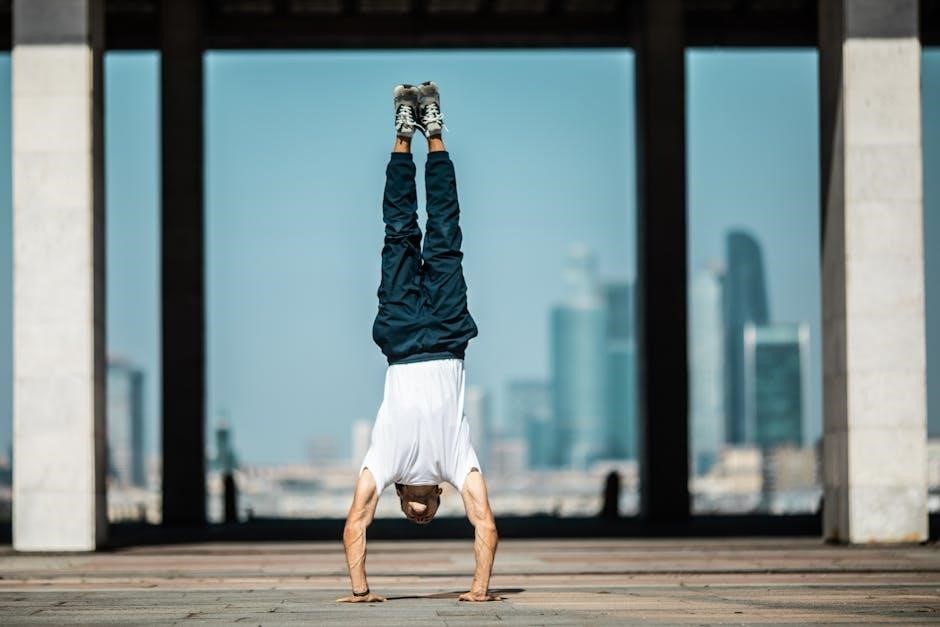
Handstand push-ups are an advanced calisthenics exercise demanding significant upper body strength, balance, and core stability. Executed by performing a push-up while inverted, they heavily challenge the shoulders, triceps, and core muscles. This movement isn’t simply about strength; it’s about controlled inversion and precise form.
Beginners should start with progressions, such as wall-assisted handstand holds to build shoulder endurance and stability. Gradually work towards controlled handstand push-ups against a wall, focusing on maintaining a straight body line. As strength improves, attempt freestanding handstand push-ups, starting with small ranges of motion.
Safety is paramount; practice near a soft surface and consider a spotter. Strengthening supporting muscles – like the core and scapular stabilizers – is crucial. Consistent practice and a focus on proper technique will unlock this challenging and rewarding calisthenics skill.
Human Flag
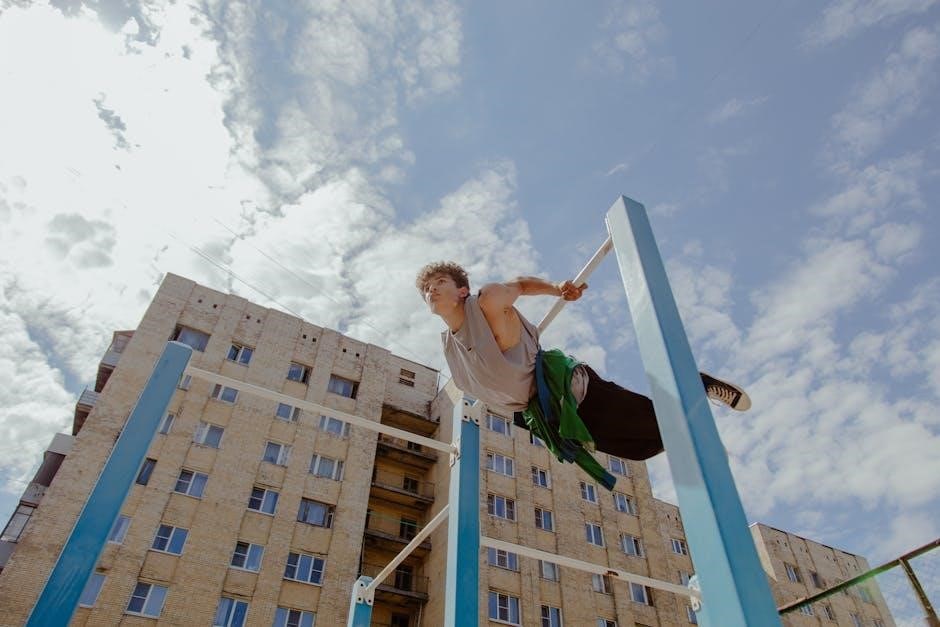
The Human Flag represents a pinnacle of calisthenics achievement, demanding exceptional core strength, shoulder stability, and grip power. This visually striking exercise involves holding the body horizontally, parallel to the ground, while gripping a vertical structure – resembling a flag waving in the wind.
Progressing towards a Human Flag requires a dedicated training regimen. Begin with isometric holds, gradually increasing duration, and focus on building unilateral strength through exercises like one-arm planks and Australian pull-ups. Scapular protraction and retraction drills are vital for shoulder stability.
Mastering the negative – slowly lowering into the flag position – builds eccentric strength. Safety is crucial; use a sturdy structure and consider a spotter. Consistent practice, coupled with targeted strength training, will ultimately unlock this impressive display of body control.

Creating a Calisthenics Workout Routine
Effective routines blend warm-ups, targeted exercises, and cool-downs, prioritizing progressive overload to continually challenge your body and unlock new levels of fitness.
Warm-up and Cool-down
Prioritizing preparation and recovery is crucial for maximizing results and minimizing injury risk within a calisthenics routine. A dynamic warm-up, involving movements like arm circles, leg swings, and torso twists, prepares muscles and joints for exertion, increasing blood flow and flexibility.
This enhances performance and reduces the chance of strains. Conversely, a cool-down, incorporating static stretches held for 20-30 seconds, aids in muscle recovery, reduces soreness, and improves long-term flexibility.
Effective cool-down stretches target the muscles worked during the session, promoting relaxation and restoring range of motion. Neglecting either the warm-up or cool-down can compromise training effectiveness and increase susceptibility to injury, hindering progress and potentially setting back fitness goals.
Progressive Overload in Calisthenics
Consistent progress in calisthenics hinges on the principle of progressive overload – gradually increasing the demands placed upon your muscles. Unlike weightlifting, where weight increments are straightforward, calisthenics requires creative adjustments. This can involve increasing repetitions, sets, or reducing rest time between sets.
Modifying exercise variations to increase difficulty is also key; transitioning from knee push-ups to standard push-ups, or progressing to decline push-ups, exemplifies this.
Furthermore, focusing on improving form and control enhances the challenge. Ultimately, progressive overload ensures continuous adaptation, preventing plateaus and fostering strength and skill development. Without it, the body adapts to the existing stimulus, limiting further gains and hindering long-term fitness improvements.